Posted 6 years ago
 ho2cultcha
(5063 items)
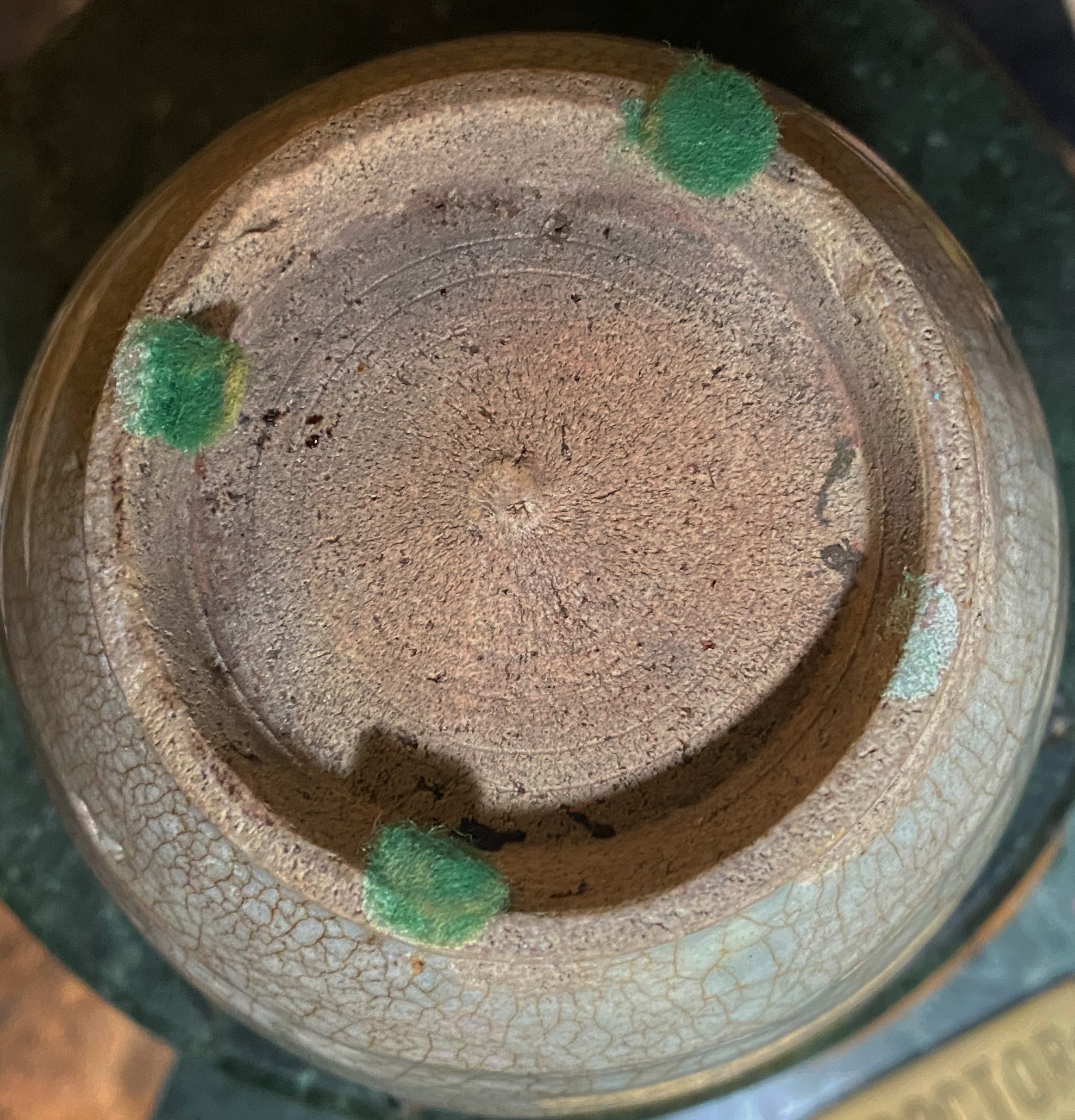
I think that this must be japanese - from the shape. Not a known Chinese shape. But it does have a high foot rim and a nice celadon crackle. Any info appreciated.
Crackle Glaze Vase - unusual shape | ||
| Japanese Pottery201 of 1280 |  |  |



 vcal loves this.
 Blammoammo loves this.
 racer4four loves this.
 blunderbuss2 loves this.
 Watchsearcher loves this.
 dlpetersen loves this.
 Newfld loves this.
 jscott0363 loves this.
 vetraio50 loves this.aura loves this.
 Ben loves this.
 dav2no1 loves this.
 kwqd loves this.
 fortapache loves this.
Create a Show & TellReport as inappropriate
Posted 6 years ago
ho2cultcha
(5063 items)
I think that this must be japanese - from the shape. Not a known Chinese shape. But it does have a high foot rim and a nice celadon crackle. Any info appreciated.

Help us close this case. Add your knowledge below.
Create an account or login in order to post a comment.



i like this but i don,t know , the orange crackle won,t help me , because the timespread is too wide, i ran gunpowder yars , but the comparison is wrong
i think this is rather delicate i think you have done well , cant substantiate
thanks apostata!
This piece drives me a bit nuts for a few reasons. The foot and footrim look like Yuan dynasty - as does the celadon crackle, but i think i'm the only one who sees it! [never a good sign]
no i didnot forget you,and we got no concenses, at a rather high level, and i am just on ordinary hillbilly , with only stemina and no talent and a gigantic database
need also a japanese database for the shaping
cyl
i ran 46 japanese shapings the sampling of them . but nothing is close enough
Before the flowering of blue-and-white ware at this site in the fourteenth century, the kilns at Jingdezhen were producing thin porcelain covered with a pale bluish green glaze that is known as Qingbai ware (literally green-white ware). This vase is a rare example of early Qingbai pieces in which the glaze is very thin and very pale. In later pieces, the Qingbai glaze is the pale blue-green that is most
question 2 you are right but the lack of inner slanting got a wider spread then only Yuan for instance Kangxi
there are fi also in the KANgxi period
Well there are what they call concentrixs bottoms during , but not much and certainly not in this way , the stria are to sharp , to many concentrix in my opinion, and we need some some disconcruency , and the lck of agglutination is real worrying
the other question is what kind of vessel is it , WELL I HAVEN,T GOT A CLUE, some experts say jarlet , other state endorsement pottery for excavations , well that sucks because i know shaping rather well, i am probably getting old
the 18 century glazed got imo the some criteria
actually i got a premisse for the the deteriation of the glazing ( lets say the color differencec in the smooches ) so i run late 19 century , that make sense imo , concencentrix can also be explained
next possible question , does this s this premiesse sucks , no on the contrary, the vase is in excellent condition ( ad random smooches is good for the authentifcication)and the tonality combination is very nice
Actually i think , but it may sound strange you are better of then mij premisse 1880-1920 then your YUAN premisse
IMO this is value so well done
drives me mad, drives drives youy , i, was wrong , freek was the easy way out with a spread of 400 years as far i can mij archive
discription won,t help us because it is noted as zuanzhu de xingzhuang, at de auctions, well that,s meant S,,,because it means someting like remarmarkle shape or something like prominent shape
most of the expert judge this as early ming , a sort of belated imitated Yuan period , a few expert see this as real YUANwhetever is ,very nice
almost all of them including me (actually i am very mediocre in this)see this as SUPERB condition
well att least i got the balls to tell i was wrong, but it is very hard when the concentrics are hidden by beans of agglutinatie in the sampling
WAki
it is the shaping of an ANPING JAR,