




Posted 3 months ago
 Patriotica
(55 items)
Still have your bell bottom jeans from the 70s? Well, they are back in fashion. Except they just might be more collectible than a fashion statement.
These days, denim jeans are worn every day and come in straight cut jeans, skinny jeans, mid-rise jeans, boot cut, and yes even bell bottoms once again. But that wasn’t always the case. Once upon a time, they were hardy work clothes known as overalls and dungarees.
Dungarees, Denim, and Blue Jeans
The sturdy cloth used to manufacture the work clothes is a unique pattern where heavy ply cotton thread is woven in a 2:1 pattern where a white cotton horizontal weft thread passes under two indigo blue-dyed vertical warp threads giving the fabric remarkable strength and durability. This staggered, almost herringbone, twill pattern showing the outside garment as blue and the inside white is the characteristic blue jeans look we know today.
This unique twill pattern actually originated in the 17th century in Dongri near Bombay, India, where the word “dungaree” originated. At about the same time, a similar twill cotton fabric dyed indigo blue was manufactured near Gênes (the French name for Genoa, Italy) where we get the English name “jeans,” while the same fabric woven near de Nîmes, France, is where we get the name “denim.” All of this fabric became popular with the working trades because it was durable, cost-effective to manufacture, and affordable.
While durable, all of the overalls, pants, smocks, uniforms, and shirts made from this fabric had a tendency to get quite worn near pockets and zippers with constant daily use. Jacob Davis, a tailor in San Francisco by 1872, used a lot of the indigo twill fabric he bought from the Levi Strauss & Co. to make work clothes for his dry goods business. As the story is told, Davis wrote to Levi Strauss that year suggesting they work together to reinforce the work clothes with copper rivets at the pockets and zippers. The next year, they had a patent (US patent No. 139,121 for an “Improvement in Fastening Pocket-Openings”), and a flourishing business in “blue jeans” was born.
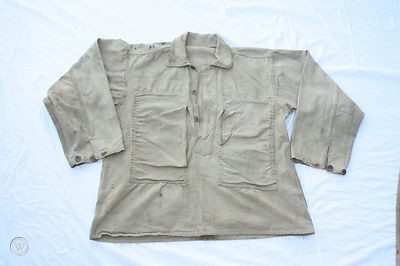
And it wasn’t just Levi Strauss & Co. making a business of denim work clothes. OshKosh B’Gosh, Hudson Overall Co., Sears, Roebuck, JC Penney, and Montgomery Ward catalog companies began selling their own brands in the 1890s. Lee jeans were introduced by the Lee Company in Salina, Kansas, with the Lee Union All, a one-piece overall used by the US Army during World War I, although separate shirts and pants were made as well. Wrangler jeans started its denim business in the 1920s. Early denim was more brown cotton plain weave such as this WWI US Army shirt that sold for $1,125 in 2012 (image 3). The first Levi workwear was similar in design and weave in 1872.
These durable work clothes were sold primarily to farmers, miners, dockworkers, and all manner of ranch hands in the American West. By the 1950s, though, actors Marlon Brando and James Dean were sporting a white t-shirt and blue jeans in their angst-ridden, anti-establishment films, and the clothing became the new “cool” look (it helped that the parents disliked it). By the 1980s, even President Ronald Reagan was seen in blue jeans while clearing brush on his ranch and “cool” went mainstream. Now blue jeans have become everyday wear as well as a working uniform. As more and more companies entered the denim leisure market, competition grew by the end of the 20th century. Designers like Calvin Klein, Gloria Vanderbilt, Ralph Lauren, and others featured their own personal lines of denim wear with their own unique patterns and characteristics.
And now they are collectible, too.
What to Look For
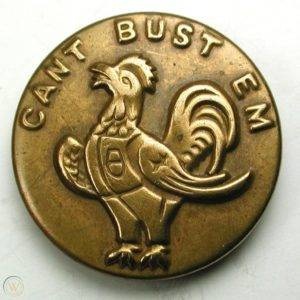
Blue jeans can be dated based on certain iconic manufacturing characteristics beginning with the Levi Strauss & Co. jeans. Contrary to myth, Levi Strauss never had any inventory available during the Gold Rush period of the 1850s. But a brand called Can’t Bust Em brand (image 2) denim work clothes were sold to early gold miners that were mostly the full overalls without rivets (the brand has been part of the Lee brand since the 1940s).
Early Levi Strauss denim was originally a brown cotton canvas type material known as “duck,” a more tightly woven material with the fly in front for men and a fly on the left side for women. Blue indigo dye was introduced by 1873 at the same time the famous copper rivets were added along the pockets and fly.
A denim jacket was introduced mostly for railroad workers as a “triple pleat blouse” in its 1874 catalog, having round bottom pockets and box stitches. The five-pocket design (two front, a watch pocket, and two in the back) became standard in 1890 with the “501” brand. A leather label featuring two horses pulling the jeans apart to show their sturdiness was introduced in 1886.
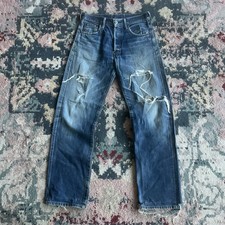
Each company had its own unique branding on each pair of jeans, and that proved a problem for Levi Strauss & Co. That is when the little red embroidered cloth tab (image 1) was introduced in 1936 in order to mark their jeans as the iconic original about the same time that Levi’s first introduced the denim shirt in 1938. Curiously, women had their own line of denim wear beginning in 1949, and their line is collectible as its own category.
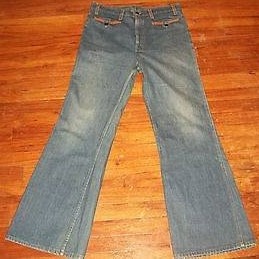
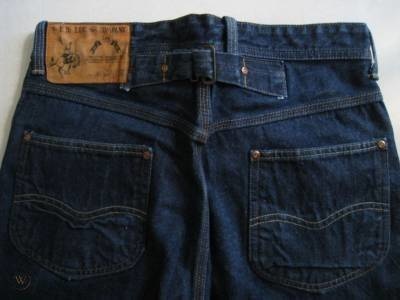
Overall, condition isn’t a major issue for very early vintage denim whether as a jacket, shirt, or trouser. It only really matters if they are intended as a donation or for resale, particularly when intended for overseas markets. A vintage cowboy Lee 101 jeans dated 1928 sold for $71 in 2010 (image 4).
Vintage cowboy Lee 101 jeans dated 1928, for example, sold for $71 in 2010 in almost unused condition. A denim jacket dated to the 1920s in good condition brought $2,500 in 2009. Not to worry, though, your early denim jeans, jacket, shirt, overalls, and shorts are still fashionable as a collectible with values ranging from $15 to $40 depending on condition.
With so many variations of jeans and so many companies producing denim work and casual wear over the last 150 years or so, the various manufacturing details such as buttons, pockets, zipper and button fly, style, and color variations can make a difference in value. Perhaps online sites such as Vintage Work Wear.com can help or a collector’s guide to Levi’s jeans at heddels.com can provide a more perfect fit.
No matter the era, no matter the fit, denim in any form is just as durable today as it was once upon a time. Only now, denim is just as collectible, too.
This article was adapted from the original published at WorthPoint.com.